Celebrating 100 years of the electrified suburban lines
By Doug Davidson, Friends of Pullman Board Member
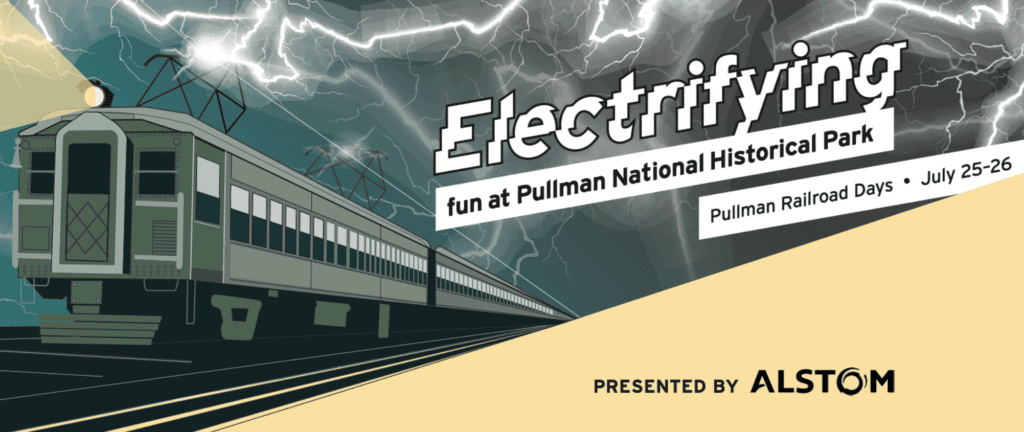
As we prepare to host our 2026 Railroad Days and celebrate 100 years of electrification, Friends of Pullman Board Member Doug Davidson teases some of his research on how the Illinois Central gave Chicago its lakefront, its suburbs – and its railcars, built in Pullman. Come experience the railcars and rest of the history this July 25 and 26 at Pullman National Historical Park.
Special thank you to our partners at Monticello Railway Museum and Lake States Railway Historical Association for the research, materials, time and energy that they’ve donated to make our Railroad Days exhibits possible.
A Railroad in the Lake
The Illinois Central was created by an Act of Congress in 1850–the nation’s first land-grant railroad–with a main line from Cairo to the northwest corner of the state and a branch line to Chicago. When the IC reached the city, it was uncertain whether the city fathers would allow it to enter the central business district along the lakeshore. But the railroad turned out to be the solution to a problem that had plagued Chicago since the early 1840s: erosion and flooding along the lakeshore. At times, storms threatened to wash away the mansions along Michigan Avenue. Chicago needed breakwaters but could not afford them.
On June 14, 1852, the city council granted the IC a 300-foot-wide right-of-way located on the bed of Lake Michigan. To make the route usable, the railroad built breakwaters, dikes, landfills, and a trestle in the lake. For many years, urban preservationists have rued the day the city allowed its lakefront to be sullied by a railroad but pragmatism outweighed aesthetic concerns in 1852.
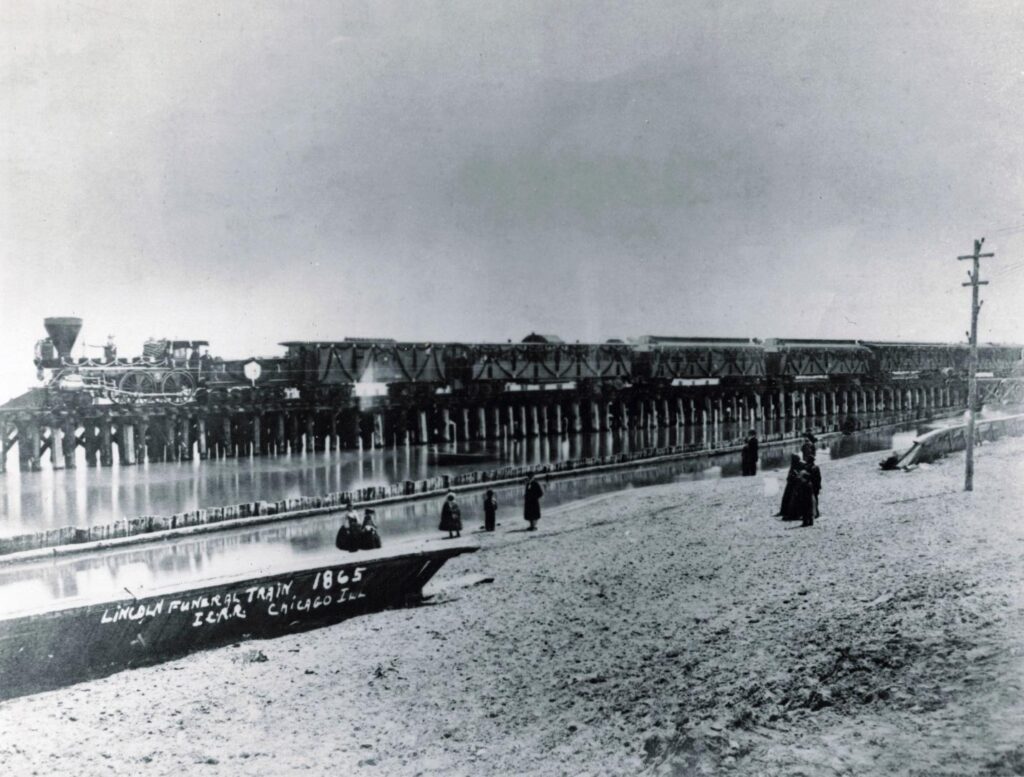
Lincoln funeral car on the Illinois Central lakefront tracks, Chicago, 1865. Courtesy of Doug Davidson.
The Suburban Service Grows
Scheduled suburban service began on July 21, 1856, with the Hyde Park Special. The Great Chicago Fire of 1871 stimulated home building along the IC as families burnt out of their homes moved to the uncongested south side, and by 1880 the railroad was carrying 1.5 million suburban passengers a year. With the construction of the Pullman Palace Car Works and model town at 111th Street in 1880, the IC established a station at Pullman, architecturally harmonious with the Pullman buildings – and even ran excursion trains for city dwellers to keep tabs on the town’s construction.
The 1893 Columbian Exposition put the suburban service on the world stage. During the fair’s 182 days, the IC operated 40,116 special trains carrying 8.7 million passengers – on a single October day, over half a million riders – with a perfect safety record.
Problems and Solutions
Not everything the railroads brought was beneficial. Newspapers of the period referred to “the carnage at the crossings,” urging measures to reduce deaths where pedestrians and wagons were struck by trains. The solution was grade separation, and because of the expense, it took municipal action to make it happen. The first such ordinance for the IC, passed May 23, 1892, required the railroad to elevate its tracks through Hyde Park in preparation for the World’s Fair – work completed within a year. Over the following three decades, the IC complied with eight ordinances in all, depressing its tracks downtown and elevating them across the South Side. The tracks through Pullman were elevated in 1917.
The other problem was smoke. Thousands of steam locomotives spewing coal smoke and cinders drew increasing public scrutiny, and as early as March 1897 the IC had created a special committee that concluded electrifying the suburban service was feasible.
The Lake Front Ordinance
After the Columbian Exposition, Daniel Burnham’s 1909 Plan of Chicago made its highest priority returning the entire lakefront to public use – proposing that landfill be used to construct parkland east of the Illinois Central right-of-way. The location of the IC’s tracks, and the railroad’s riparian rights along the shore, stood in the way.
The resolution came in the Lake Front Ordinance of January 21, 1919. The IC relinquished its riparian rights to hundreds of acres of Lake Michigan shoreline; in return, it was allowed to widen its right-of-way, including land the city had reclaimed from the lake. The agreement allowed the city to place landfill east of the IC and develop new parkland. Eventually, the new grounds would be home to Grant Park, Lake Shore Drive, the Field Museum, the Adler Planetarium, the Shedd Aquarium, Soldier Field, and the site of the 1933–34 World’s Fair; in later years, Monroe Harbor, Meigs Field, and McCormick Place were added to the lakefront created by the ordinance in 1919.
That same year, another ordinance required the IC to electrify its suburban service by 1927.
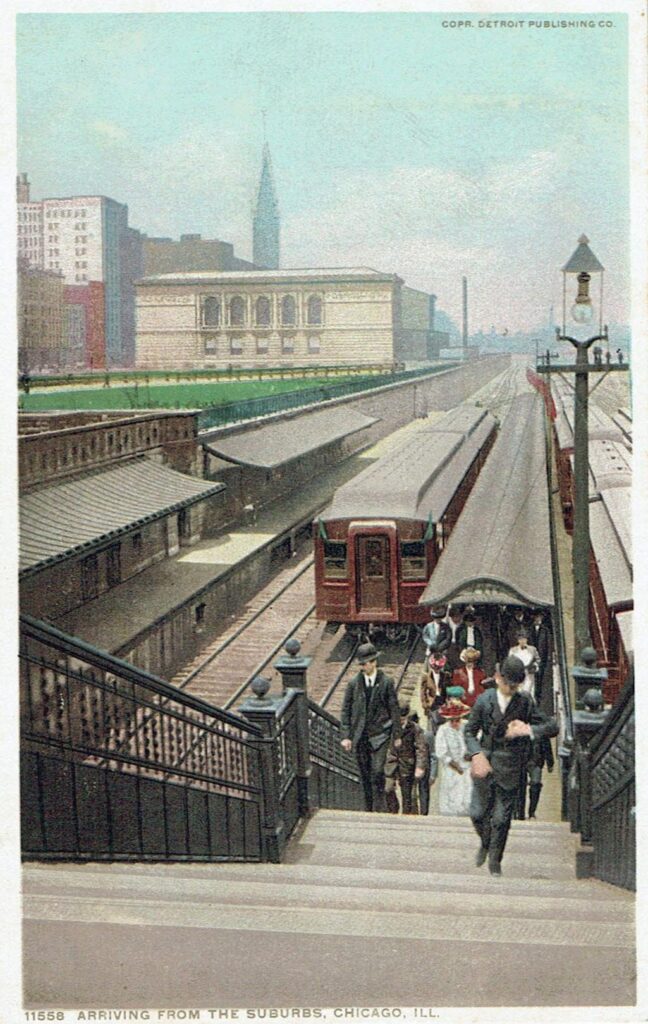
Postcard of the elevated Van Buren Street Station, Chicago, 1907. Courtesy of Doug Davidson.
Electrification!
New equipment began arriving in 1921, when the IC received 20 trailer coaches from the Pullman Company, followed by 25 more in 1924. In 1926 came 85 more trailers and 130 motor coaches, married to trailers in semi-permanently coupled pairs. Each car seated 84 passengers, with room for 100 more standing. The new electric trains could accelerate from zero to 28 mph in 20 seconds–far quicker than the steam trains they replaced–with a top speed of nearly 70 mph.
Electrification also gave the suburban service an exclusive right-of-way, separate from freight and passenger mains – the reason Metra Electric trains run free of freight interference to this day.
The Pullman multiple unit coaches did yeoman’s duty moving the masses through the Depression, a second World’s Fair, and World War II, when ridership peaked at 47 million passengers in 1946. New bi-level cars began replacing them in 1971, but 88 of the originals soldiered on through rush hours until 1979 – more than half a century of service.
Coming Home
When the IC began retiring the Pullman fleet in 1972, it donated a motor-trailer set – car Nos. 1198 and 1380, both built at Pullman in 1926 – to the Illinois Railway Museum (IRM). No. 1198 is the only surviving motor car.
This summer, thanks to our partnership with IRM, both cars are returning home to Pullman for one weekend. Step aboard to experience the railcars and learn the rest of the fascinating story at Railroad Days, July 25 & 26, only at Pullman National Historical Park.